Typical settings: Prohibition-era crime stories, World War II combat films, early 20th-century American settings, and stylized gangster productions.
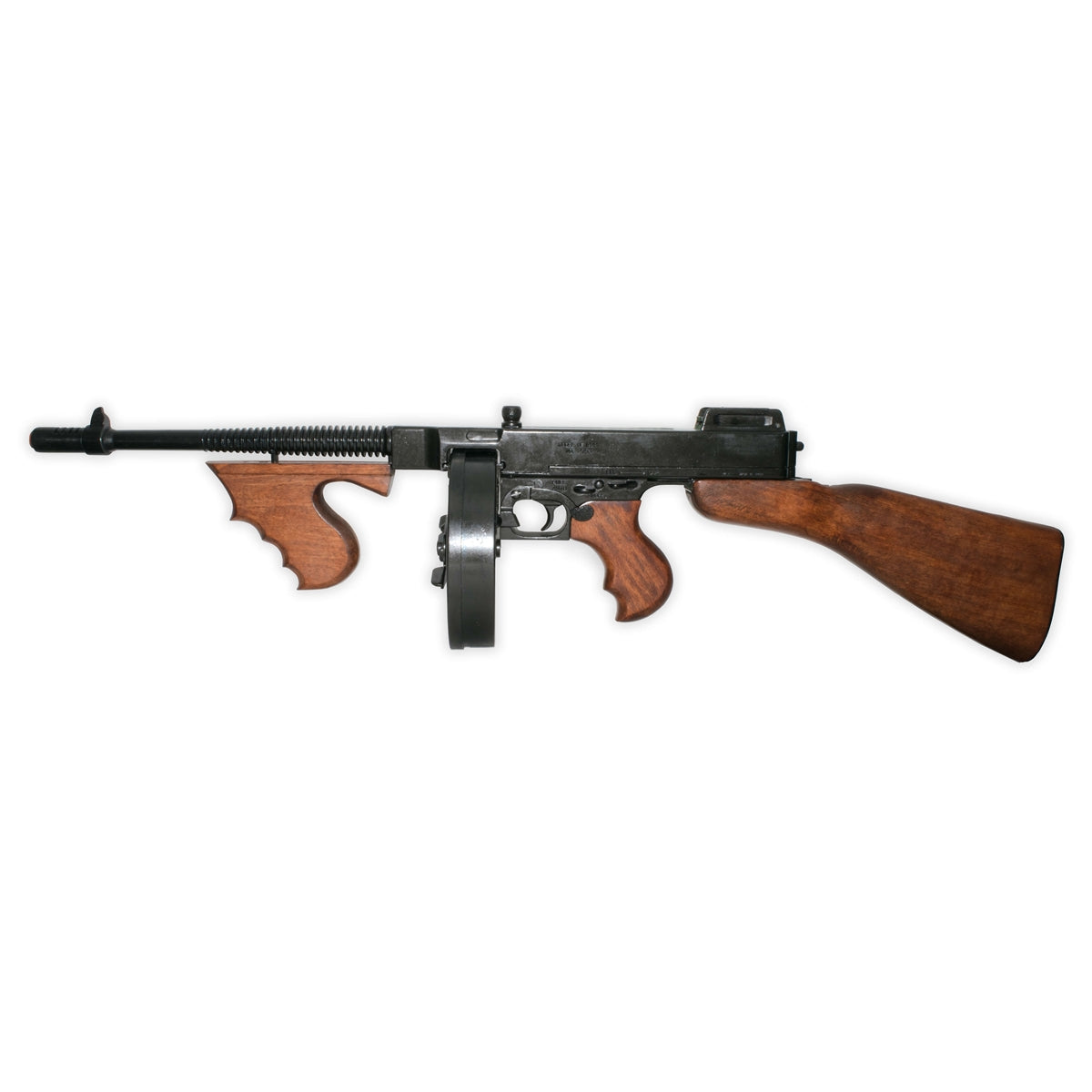
This non-firing replica rifle is modeled after the M1928 American submachine gun, a compact automatic firearm developed in the aftermath of World War I. The original design was created in 1918 by John Taliaferro Thompson, whose work would become one of the most influential firearm designs of the early 20th century.
Historically, the M1928 variant entered U.S. military service prior to World War II and continued to see use through the war and into early Cold War conflicts. Chambered for .45 ACP, it was valued for its controllability and distinctive profile, and could be fitted with either straight box magazines or high-capacity drum magazines, which became one of its most recognizable features.
Cinematically, the firearm developed a powerful second identity during the Prohibition era (1920–1933), where it became strongly associated with organized crime and urban violence. Film, television, and period media cemented its reputation as the archetypal “gangster gun,” often emphasizing drum magazines and rapid-fire imagery to instantly signal lawlessness, excess, and danger—sometimes far beyond its actual historical prevalence.
Manufactured in Spain by Denix, a respected replica maker founded in 1967, this non-firing replica is constructed of metal and wood and features a simulated loading and firing mechanism with a removable drum magazine. It is intended strictly for visual, performance, and display use, offering the iconic silhouette without live-fire capability.
Commonly depicted with:
-
Prohibition-era gangsters and mob figures
-
World War II American soldiers
-
Early 20th-century law enforcement
-
Criminal kingpins and underworld characters
-
Stylized historical antagonists